 Skip to content
IPL Photofacial in Baton Rouge, LA
IPL Skin Rejuvenation in Baton Rouge, LA ·
Led
by Samantha Avera, DNP-BC
There is a specific kind of skin change that accumulates slowly enough that patients adjust to it before they notice it: the brown spots that appear after summers of sun, the flush that has settled into something more persistent, the overall tone that used to be even and now reads as patchy in certain light. These are not signs of neglect. They are the predictable result of years of UV exposure on skin that was otherwise well cared for. Topical products manage them at the surface. IPL photofacial in Baton Rouge, LA, treats the pigment and vascular changes beneath the skin.
Intense Pulsed Light (IPL) photofacial delivers broad-spectrum light energy into the skin to target melanin in pigmented lesions and oxyhemoglobin in visible blood vessels, breaking down discoloration and reducing redness with minimal disruption to the skin surface. At Coco Beauty Bar & Medical Spa, every IPL treatment begins with a skin assessment by Samantha Avera, DNP-BC, whose decade of clinical experience in dermatology and aesthetic medicine informs both the filter selection and the honest candidacy conversation that precedes every session.
Our Approach: Precision. Candidacy. Even Results.
IPL treatment is one of the most effective treatments available for pigmentation and vascular irregularity, and one of the most dependent on appropriate patient selection. The technology targets melanin and hemoglobin selectively, so it works well when these targets are distinct from the surrounding skin.
In patients with darker skin tones, where the contrast between the target and the background tissue is lower, the risk of unintended thermal response increases. Understanding that distinction and being direct about it are central to how IPL is practiced at Coco.
Full Skin Assessment
Every consultation begins with an evaluation of skin tone, the specific pigmentation or vascular concern, treatment history, and sun exposure patterns before any filter or parameter is selected.
Candidacy First
IPL photofacial produces the most reliable results in Fitzpatrick skin types I–III. In patients with medium-to-deep skin tones, the risk of post-inflammatory hyperpigmentation or a surface thermal response is elevated and requires direct discussion before proceeding.
Precise Filter Selection
IPL devices use interchangeable filters to target different wavelength ranges: shorter wavelengths for vascular concerns and longer wavelengths for deeper pigmentation.Samantha Avera selects the appropriate filter based on your specific concern, not a standard setting.
Long-Term Skin Health
IPL results are meaningful and lasting when supported by consistent post-treatment sun protection. In Baton Rouge's UV environment, that maintenance conversation is part of every treatment plan.
Samantha Avera, DNP-BC
Samantha Avera approaches IPL photofacial treatment from the perspective of an experienced clinician, drawing on her background in critical care, dermatology, and luxury medical aesthetics to evaluate IPL as a precise, medically guided treatment rather than a one-size-fits-all cosmetic procedure. Her expertise allows her to carefully assess pigmentation, vascular concerns, skin tone, and long-term skin health to determine whether IPL is truly the right approach for each patient.
Every consultation is led with education, honesty, and individualized planning. Samantha Avera ensures patients understand what IPL can realistically improve, what it cannot, and how proper sun protection and skincare influence long-term results. Her goal is not simply treatment, but safe, evidence-based care tailored to each patient’s skin biology and lifestyle.
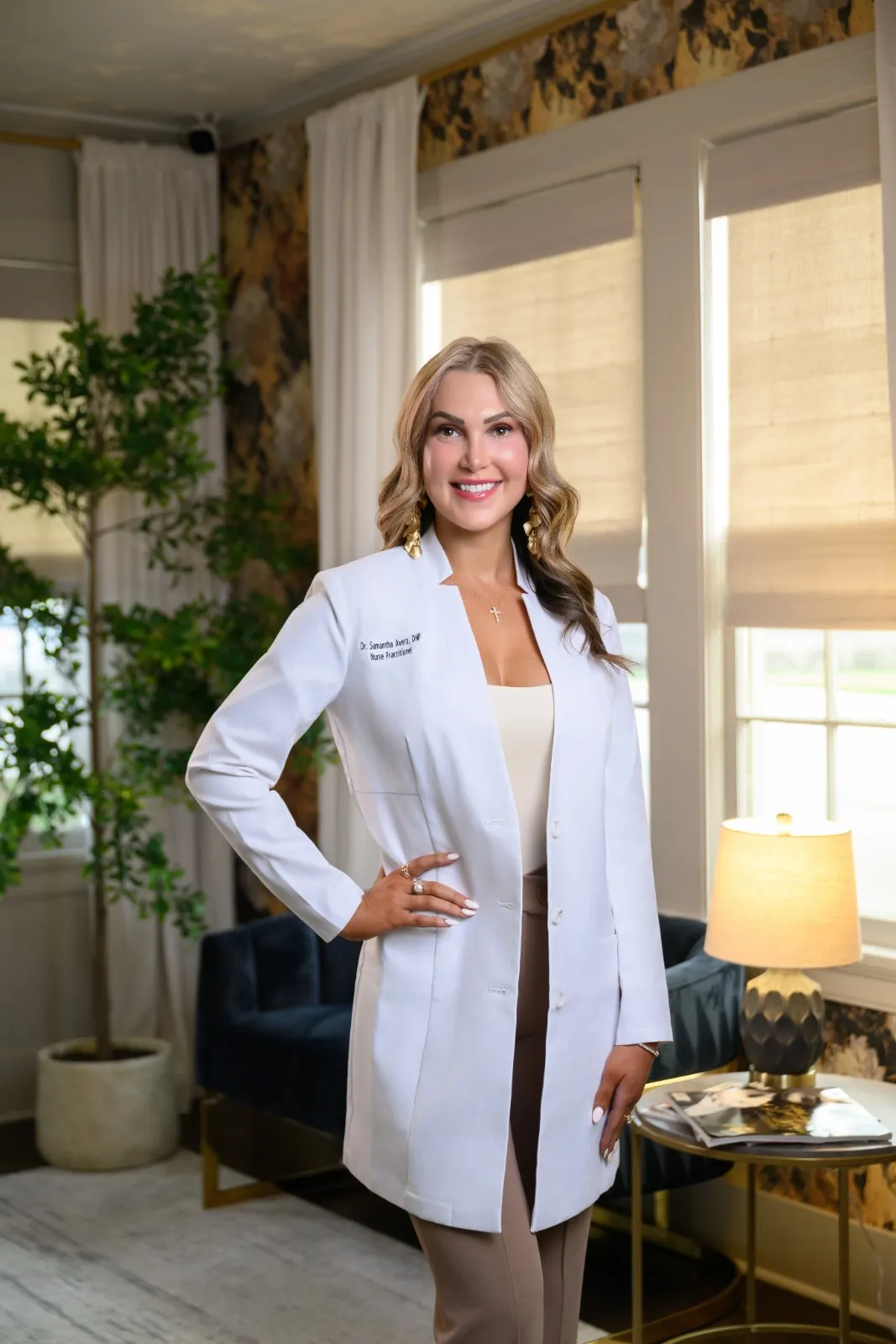
- Doctor of Nursing Practice, Board Certified, with subspecialty training in aesthetic and functional medicine
- 10+ years of clinical experience spanning critical care, dermatology, and luxury medical aesthetics
- Advanced specialization in laser and energy-based treatments, injectables, biostimulants, and PRP/PRF therapy
- Evidence-based, individualized treatment planning with deep respect for diverse skin tones and clinical complexity
How Does IPL Photofacial Work?
IPL delivers pulses of broad-spectrum light, spanning roughly 500 to 1200 nanometers depending on the filter applied, into the skin. Unlike lasers, which emit a single focused wavelength, IPL uses a range of wavelengths simultaneously, allowing it to address multiple targets in a single pass.
The mechanism is selective photothermolysis: light energy is selectively absorbed by chromophores in the skin—melanin in pigmented lesions and oxyhemoglobin in blood vessels—converting it into heat.
Pigmented Lesions
Melanin in sun spots, age spots, freckles, and post-inflammatory discoloration absorbs IPL energy and converts it to heat. The targeted cells are damaged and rise to the surface as darkened debris in the days following treatment, then shed, leaving clearer skin underneath. Most patients report that the treated spots appear slightly darker for 3 to 7 days before resolving. This is the expected response, not a side effect.
Vascular Concerns
Oxyhemoglobin in visible capillaries, diffuse facial redness, and rosacea-related vessels absorb IPL energy at specific wavelengths, causing the vessel walls to coagulate and collapse. This redness-reduction laser effect clears the treated vessels over the days and weeks following treatment, progressively reducing the redness and flushing visible at the surface.
Collagen Stimulation
A secondary benefit of IPL, distinct from its targeted pigment and vascular effects, is mild thermal stimulation of dermal fibroblasts, which produces a modest collagen remodeling response over the weeks following treatment. This contributes to the overall improvement in skin tone, texture, and quality that patients notice beyond the specific clearance of spots and redness.
Commonly Treated Concerns
Sun damage and solar lentigines
Facial redness and rosacea
Post-inflammatory hyperpigmentation
Freckles
Poikiloderma of Civatte
Uneven skin tone
Décolleté and hands
Why is IPL Particularly Relevant in Baton Rouge?
The skin changes that bring most patients to an IPL photofacial consultation are not incidental; they are the accumulated product of years in a specific environment. Baton Rouge averages over 214 sunny days annually, with UV index values regularly reaching 10 or above from April through October. That sustained UV exposure drives melanin overproduction in the epidermis, producing the brown spots, uneven skin tone, and freckling that patients first notice in their 30s and that deepen through their 40s.
The city’s outdoor culture accelerates the timeline. LSU tailgates from September through November, the Krewe of Artemis parade, the Baton Rouge Blues Festival, year-round outdoor dining, and the social calendar here rarely pause long enough for cumulative UV to fully recover between exposures. Long I-10 and I-12 commutes add asymmetric driver-side UV that accumulates on the left side of the face and neck over the years, a pattern Samantha Avera sees consistently in her Baton Rouge practice.
- Brown spots, age spots, or sun-induced freckling have become more prominent
- Your skin tone is uneven in a way that foundation covers, but doesn't correct it
- You have persistent facial redness or a flushing pattern that has become more consistent
- The skin on your neck or chest has a mottled, reddish-brown discoloration
- You want a treatment with minimal downtime that produces visible improvement
The Difference Between IPL Done Well and a Generic Facial
IPL photofacial is sometimes marketed as a maintenance facial, something mild and universally appropriate that anyone can receive. That framing understates both the treatment’s genuine clinical effectiveness and the importance of patient selection.
IPL treatment is a targeted energy-based approach. Applied without proper assessment of skin tone and the specific concern being addressed, it can produce inconsistent results, surface thermal response, or post-inflammatory pigmentation changes that take longer to resolve than the original concern.
What we don't do
Treat IPL as a generic skin-brightening service appropriate for all skin tones without a candidacy evaluation. Apply the same filter to every patient regardless of whether the concern is pigmented or vascular. Minimize the importance of post-treatment sun protection.
What we do instead
Evaluate your specific concern, skin tone, and treatment history before selecting parameters. Explain what the treatment will and won't address. Build a series plan appropriate to the degree of pigmentation or vascular change you're dealing with.
On sun protection
IPL results degrade quickly without consistent sun protection in the weeks and months following treatment. In Baton Rouge's UV environment, that maintenance is not optional. Samantha Avera discusses it at every appointment because the outcome depends on it.
What to Expect at Coco Beauty Bar & Medical Spa
1
Your Consultation
Samantha Avera evaluates your skin tone, specific pigmentation or vascular concerns, sun exposure patterns, and treatment history. Candidacy, realistic outcomes, and what to expect during and after each session are discussed before any treatment begins.
2
Your Custom Treatment Plan
Filter selection, fluence, and pulse settings are determined based on your skin tone and the concern being treated. Most patients complete a series of 3 to 5 sessions, spaced 3 to 4 weeks apart, for optimal results. Maintenance sessions, once or twice annually, help sustain the improvement.
3
Treatment Day
A cooling gel is applied before the IPL handpiece delivers light pulses, which cause a brief heating sensation. Sessions last 20 to 30 minutes. Post-treatment, pigmented lesions may darken temporarily and resolve within three to seven days, while mild redness usually fades within a few hours.
4
Results & Maintenance
Pigmentation clearance is visible as treated spots darken and shed over the first week. Vascular improvement progresses gradually throughout the series. Most patients see meaningful improvement in tone after two to three sessions, with the full result apparent after the complete series. Consistent sun protection afterward is essential to maintaining the outcome in Baton Rouge’s UV environment.
What Our Patients Are Saying

Samantha did an amazing job. She did exactly what we discussed during my consult. It was a faster and less painful experience than I was expecting. Absolutely will recommend her to others!
I went today and saw Samantha. She is AMAZING and so good at what she does. She really listens to her patients and answers all the questions (I had A LOT!). Everyone at Coco is so very sweet and inviting! Thank you so much for a wonderful experience!
Frequently Asked Questions
Is IPL safe for all skin tones?
IPL is most appropriate for Fitzpatrick skin types I–III; patients with medium to deep skin tones face an elevated risk of post-inflammatory hyperpigmentation, which requires careful evaluation before proceeding.
How many sessions will I need?
Most patients complete a series of three to five sessions spaced three to four weeks apart, with maintenance sessions once or twice annually. The number of sessions depends on the degree of pigmentation or vascular change, skin tone, and individual response. Significant sun damage accumulated over many years typically requires more sessions than early or mild pigmentation.
What does the treated skin look like during healing?
Treated pigmented lesions will appear darker for three to seven days before shedding; this is the expected response, not a complication. The darkening reflects the damaged melanin rising to the surface before being cleared by the skin.
Is IPL painful?
Most patients describe the sensation as a brief snap of heat at each pulse, which is tolerable. The team applies a cooling gel before treatment to protect the skin surface and reduce discomfort. Areas with denser pigmentation or more visible vasculature tend to produce a slightly more intense sensation. Sessions are typically 20 to 30 minutes, which limits cumulative discomfort.
When will I see results?
Initial pigmentation improvement is visible within one to two weeks after the first session as treated spots darken and shed; vascular improvement develops progressively across the series.
Can IPL treat rosacea?
Yes, IPL photofacial is one of the more effective non-prescription rosacea treatments for the vascular component of rosacea, including diffuse redness, flushing, and visible facial capillaries. As a redness-reduction laser, IPL targets oxyhemoglobin in the affected vessels, causing them to coagulate and gradually clear.
Will I still look like myself?
Yes, IPL improves skin tone and reduces pigmentation and redness; it does not alter facial structure or expression. The goal is skin that looks cleaner, more even, and more rested, recognizably yours, without the UV-accumulated discoloration layered on top. The improvement reads as better skin, not as a procedure.
Your Consultation Begins With a Conversation
Years of South Louisiana sun produce a specific and legible pattern of skin change. Samantha Avera will evaluate your pigmentation, vascular concerns, skin tone, and sun exposure history and build a treatment plan based on what’s actually happening in your skin rather than a generic protocol. Whether you’re addressing a decade of accumulated sun damage, persistent redness, or uneven tone that skincare has stopped improving, the consultation is where that conversation starts.
Coco Beauty Bar & Medical Spa · Baton Rouge, Louisiana.
Individual results vary. All treatments are performed under the supervision of Samantha Avera, DNP-BC.
Quality